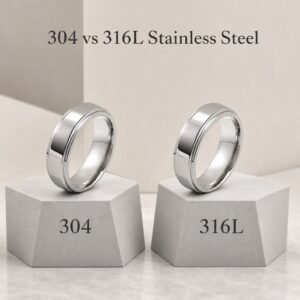
When sourcing stainless steel jewelry, one of the most common questions is simple: Should you choose 304 or 316L stainless steel?
The answer is not simply that one is “good” and the other is “better.”
Both are widely used stainless steels with good corrosion resistance and a strong track record in jewelry manufacturing. The real difference is how they perform under different wearing conditions, how much they cost to manufacture, how they support your product positioning, and how consumers experience the finished jewelry over time.
There is also another factor buyers often overlook: nickel release.
Both 304 and 316L contain nickel. In fact, 316L normally contains more nickel than 304. However, total nickel content is not the same as the amount of nickel that can actually migrate from the finished surface during skin contact. Because 316L has better corrosion resistance, it can also show lower nickel release under comparable surface and testing conditions.
For a price-driven wholesale collection, 304 may offer the better commercial value. For a consumer-facing brand selling everyday, premium, PVD-coated, sensitive-skin or long-wear jewelry, the additional cost of 316L can often be easier to justify.
The right question is therefore not:
“Which stainless steel is better?”
It is:
“Which stainless steel better matches my customer, sales channel and product promise?”
What Is the Real Difference Between 304 and 316L?
304 and 316L are both austenitic stainless steels. They share many characteristics, including good formability, good corrosion resistance and the ability to achieve a clean, polished jewelry finish.
The key difference is their alloy composition.
316L contains molybdenum, typically around 2–3%, while standard 304 generally does not. It also typically contains a higher proportion of nickel. Molybdenum is especially important because it improves resistance to localized corrosion, particularly in chloride-containing environments. Outokumpu, for example, lists typical compositions of about 18.1% chromium and 8.1% nickel for 304L, compared with about 17.2% chromium, 10.1% nickel and 2.1% molybdenum for 316L.
For jewelry, that difference matters more than it may sound.
A necklace, ring or bracelet does not live in a laboratory. It is exposed to sweat, humidity, skin oils, cosmetics, perfume, water and, for some customers, seawater. These conditions can gradually challenge the protective passive layer on stainless steel.
304 performs well in normal conditions, but 316L gives the metal a stronger defense against chloride-related pitting and localized corrosion.
What about nickel release?
This is an important distinction for jewelry buyers.
A material can contain nickel without releasing large amounts of nickel during wear. What matters for skin-contact performance is not only the nickel inside the alloy, but also the stability of the finished surface.
In one jewelry-focused study using solution-treated and mirror-polished samples in artificial sweat, 304 showed a nickel release rate of approximately 0.08 μg/cm²/week, while 316L measured approximately 0.02 μg/cm²/week. These figures should not be treated as guaranteed values for every finished product, because polishing, passivation, coating and manufacturing quality can all change the result. They do, however, illustrate why nickel release should be evaluated separately from total nickel content.
For the EU market, this distinction is especially relevant. REACH restricts nickel release to below 0.5 μg/cm²/week for items intended for direct and prolonged skin contact, while posts inserted into pierced ears or other pierced parts of the body are subject to a stricter 0.2 μg/cm²/week limit.
So “316L” should never be used as a substitute for finished-product testing. But when nickel-release risk is an important part of the sourcing decision, 316L is usually the stronger starting point.
What Does 316L Actually Change During Everyday Wear?
Buyers sometimes hear that 316L is “harder” or “more wear-resistant” than 304. That explanation is too simple.
The mechanical hardness of 304 and 316L depends on the material condition, cold working and manufacturing process. A 316L jewelry item is not automatically scratch-proof, and switching from 304 to 316L does not mean normal wear marks disappear.
The more useful difference for jewelry is what happens after the surface starts experiencing wear.
Real jewelry is exposed to mechanical and chemical stress at the same time.
A bracelet rubs against a desk. A ring knocks against a door handle. A necklace sits against warm, sweaty skin. Earrings may be worn throughout an entire day. During summer or exercise, moisture and salts stay on the surface for longer.
This means that scratches, friction and small impacts are happening while the metal is also being exposed to a potentially corrosive environment.
When the passive surface is disturbed, 316L’s stronger resistance to chloride-related corrosion helps slow the development of corrosion around vulnerable areas.
In practical terms, under the same everyday environment, both materials can become scratched, but the damaged area on 316L is generally less vulnerable to corrosion-related deterioration.
That can mean:
less visible spotting, slower surface deterioration, fewer corrosion-related changes and a longer-lasting clean appearance.
This is much closer to what the end consumer actually experiences.
Most consumers will never ask about molybdenum, passive films or pitting resistance. They simply notice that a ring they have worn for months still looks good, or that another piece began showing spots and surface changes much sooner.
That difference in perceived product life is commercially important.
For a brand, a longer-lasting appearance can support better reviews, fewer quality complaints and stronger confidence in the product. For a wholesaler selling fast-moving, lower-priced fashion pieces, that additional durability may be less important than keeping the purchase price competitive.
At Chicolink, the material decision is therefore made together with the product structure, intended wearing environment, target market and manufacturing requirements rather than treating 304 or 316L as a universal answer. Our internal production experience also finds 316L more demanding in forming, cutting, welding, polishing and reshaping for some complex designs, which is one reason the upgrade has a manufacturing cost as well as a raw-material cost.
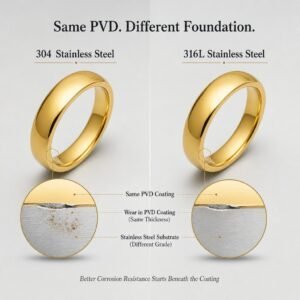
304 vs 316L for PVD Jewelry: Same Coating, Different Foundation
This is where the difference between the two materials is often misunderstood.
Suppose two gold-colored rings are produced with:
the same PVD system, the same coating materials, the same target thickness, the same color standard and the same surface-preparation quality.
One ring is made from 304 stainless steel. The other is made from 316L.
The PVD coating itself does not automatically become thicker, harder or higher-grade simply because the substrate is 316L.
If the coating specification is the same, the coating specification is the same.
The advantage of 316L comes from what is underneath it.
Why the substrate still matters
A PVD coating should be treated as part of a complete surface system rather than an indestructible shell.
During normal use, a finished jewelry piece can develop microscopic wear, small scratches or exposed areas around edges and high-contact points. A coating can also contain very small defects that are invisible to the naked eye.
When sweat, moisture or chlorides reach the base metal through one of these areas, the corrosion resistance of the substrate starts to matter.
With a 304 substrate, the exposed or affected area has a greater risk of localized corrosion under aggressive conditions.
With a 316L substrate, the molybdenum-containing steel has better resistance to this type of attack.
The important result is not that the PVD itself suddenly becomes different. It is that the material underneath the PVD is more stable when the surface system is locally compromised.
This can help the finished piece maintain a more uniform appearance for longer.
Why consumers often describe this as “fading”
This distinction is important for brands because consumers rarely diagnose jewelry problems accurately.
They do not normally say:
“The coating is intact, but the substrate around a worn edge has started to corrode.”
They say:
“The color changed.”
Or:
“The plating faded.”
From a laboratory or manufacturing perspective, coating wear and substrate deterioration are two different things.
From the customer’s perspective, they are often the same thing: the jewelry no longer looks the way it did when it was new.
This is why we find it useful to separate coating durability from perceived color durability.
Coating durability depends heavily on the PVD system itself: surface preparation, coating structure, thickness, adhesion and process control.
Perceived color durability is broader. It is the customer’s impression of the entire finished surface after real wear.
That experience is affected by both:
PVD coating performance + base-metal stability.
So, with an equivalent PVD system and thickness, 316L can provide an advantage because a more corrosion-resistant base metal is less likely to develop visible deterioration around scratches, pores or worn areas.
In simple terms:
Same coating. Different foundation. Different long-term appearance.
This is also why surface preparation matters so much. At Chicolink, PVD is handled in our in-house plating workshop, where projects can define the substrate, polishing level, coating structure, target thickness, color tolerance and durability requirements. Coating quality checks include thickness, color comparison and visible defects such as pinholes, scratches and peeling.
None of this means that 316L makes a PVD finish permanent. A poorly prepared or poorly controlled coating can still fail on 316L.
What 316L provides is a better corrosion-resistant foundation for the same coating system.
Why Does 316L Jewelry Cost More?
The price difference between 304 and 316L is not caused by one single factor.
Understanding the cost structure helps buyers decide whether the upgrade is commercially worthwhile.
First, the alloy itself costs more
316L normally contains more nickel than 304 and, more importantly, contains molybdenum.
Those alloying elements increase the underlying material cost. This is the first reason 316L starts at a higher price before the jewelry has even entered production.
Second, processing can be more demanding
Raw steel is only part of the cost of a finished piece.
Depending on the design, jewelry production may involve cutting, CNC machining, forming, drilling, welding, polishing and reshaping.
In our current production conditions, 316L can require more control during some of these processes, particularly on complex structures. More difficult processing can mean longer production time, closer tool management or additional finishing work.
Third, yield and quality control matter
A manufacturer does not calculate cost only by kilograms of steel.
The more useful number is the cost of producing an acceptable finished piece.
If a design is difficult to machine, polish or reshape, production efficiency and rejection rates also become part of the final quotation.
This is why the cost difference between 304 and 316L can vary significantly between a lightweight chain, a thick signet ring, a complex hinged bangle and a highly machined pendant.
What usually does not change: the PVD specification
This is particularly important for buyers comparing PVD jewelry.
If a 304 piece and a 316L piece use exactly the same PVD structure and coating thickness, the plating cost does not suddenly become much higher just because the base metal is 316L.
The extra cost comes mainly from the substrate and its processing, not from giving the 316L piece a mysterious “better PVD.”
And because the base metal is only one component of the final jewelry cost, moving from 304 to 316L does not necessarily mean the finished piece becomes dramatically more expensive.
Labor, stones, PVD, assembly, packaging, quality control and order volume all remain part of the total.
For many brand programs, this is exactly why 316L can make sense: the finished-unit price may increase moderately while the perceived product value can increase by much more.
Which One Should You Buy? Start With Your Customer, Not the Steel Grade
There is no single material choice that makes sense for every jewelry business.
The best choice depends heavily on who buys from you and how you sell the product.
For consumer brands, 316L is often the better investment
If you run a DTC jewelry brand, private-label collection, Amazon business, Shopify store or premium retail line, the sale does not end when the product leaves your warehouse.
You still care about customer reviews, replacements, refunds, repeat purchases and how the product supports your brand promise.
If your marketing uses ideas such as everyday wear, premium stainless steel, water resistance, long-lasting gold color or skin-friendly jewelry, the customer’s expectations are higher.
In these situations, 316L’s stronger corrosion resistance and more stable long-term performance can help reduce the gap between what the marketing promises and what the customer experiences.
“316L stainless steel” is also a recognizable material specification that brands can communicate as part of their product story.
So the commercial equation is not simply:
higher material cost = lower profit.
It can also be:
moderately higher product cost → stronger product positioning → higher perceived value → fewer quality complaints → better long-term margin.
For children’s and sensitive-skin collections, we would generally start with 316L
Products intended for children, sensitive-skin customers, pierced ears or prolonged skin contact deserve a more conservative material strategy.
Because 316L can show lower nickel release under comparable finished-surface conditions, we generally recommend making it the starting material for these programs rather than defaulting to 304.
That does not mean that every 304 product will fail nickel testing, or that every 316L product is automatically hypoallergenic.
Both statements would be misleading.
The finished jewelry still needs to be evaluated according to the target market, coating system and relevant testing requirements.
For higher-sensitivity programs, our preferred approach is therefore:
316L as the material starting point + appropriate finished-product nickel-release testing.
Chicolink can coordinate nickel-related, EN 1811, EN 12472 and other project-specific third-party testing where required; individual reports remain specific to the tested sample, material, finish and conditions rather than automatically covering every product.
For wholesalers and highly price-driven collections, 304 can be the smarter choice
A wholesaler has a different business model from a DTC brand.
If you are buying a broad assortment, turning inventory quickly and competing primarily on wholesale price, the customer may not pay enough extra for 316L to justify upgrading every SKU.
304 is still a capable stainless steel.
It offers good corrosion resistance, mature supply, flexible production and a lower starting cost. Chicolink’s sourcing guidelines also note that 304 is relatively well supplied and flexible in procurement and lead time.
For fashion-driven, promotional or short-lifecycle collections, that can make 304 the more profitable material.
The key is not to over-specify a product when the end market will not reward the upgrade.
304 or 316L? A Practical Buyer Decision Table
| Product or Business Model | Recommended Starting Point | Why |
| Price-driven wholesale jewelry | 304 | Lower cost and strong value |
| Trend or seasonal collections | 304 | Shorter product lifecycle |
| Promotional jewelry | 304 | Purchase price is usually the priority |
| Standard fashion jewelry | 304 or 316L | Depends on positioning and target price |
| DTC jewelry brand | 316L preferred | Customer experience and reviews matter more |
| Premium stainless steel collection | 316L | Better material story and corrosion resistance |
| Gold PVD everyday jewelry | 316L preferred | More stable substrate beneath the coating |
| Water-resistant / long-wear positioning | 316L | Better match for higher consumer expectations |
| Children’s jewelry | 316L preferred + testing | More conservative nickel-release strategy |
| Sensitive-skin collection | 316L preferred + testing | Better starting point for skin-contact performance |
| Beach / coastal collection | 316L | Better chloride and pitting resistance |
| Lowest possible unit cost | 304 | Protects initial purchasing margin |
| Brand focused on lower after-sales risk | 316L preferred | Better long-term product and visual stability |
Final Recommendation: Match the Material to the Business Model
304 and 316L are both useful jewelry materials. The mistake is assuming that every customer needs the same one.
Choose 304 when cost efficiency, competitive wholesale pricing and fast inventory turnover matter most.
Choose 316L when corrosion resistance, long-term appearance, PVD visual stability, skin-contact performance, customer satisfaction and premium positioning carry more commercial value.
For wholesalers, the lower cost of 304 can protect the purchasing margin.
For consumer brands, the relatively moderate cost of moving to 316L can help protect something equally important: the customer’s experience after the sale.
And that experience affects reviews, repeat purchases, returns and the price your brand is able to justify.
The best stainless steel is therefore not automatically the highest grade.
It is the material that best supports your customer, your product promise and your profit model.
Need Help Choosing Between 304 and 316L?
Chicolink Jewelry is a stainless steel jewelry manufacturer in Dongguan, China, supporting wholesale, OEM, ODM and private-label projects for international B2B buyers. Our production capabilities include product development, bulk manufacturing, in-house PVD/IP plating, quality control, packaging and third-party inspection support.
If you are developing a new collection, send us your target market, target price, product type, intended wearing conditions and PVD requirements.
We can help you evaluate whether 304 or 316L makes more commercial sense for the collection—and define the material, surface treatment and testing requirements before bulk production.