
When buyers ask whether gold-colored stainless steel jewelry will fade, they are usually asking more than a technical question.
They want to know whether the product will still look good after customers start wearing it, whether it will create unnecessary returns or negative reviews, and whether the quality shown in the first sample can still be repeated in future production.
For colored stainless steel jewelry, two finishing routes come up most often: PVD/IP coating and electroplating, sometimes called “water plating” within Asian jewelry supply chains.
PVD, or Physical Vapor Deposition, creates a thin functional coating in a vacuum environment. IP, or Ion Plating, is one commonly used PVD-based process. Electroplating works through an electrochemical process that deposits metal onto the jewelry surface.
For most stainless steel jewelry designed for regular wear—especially rings, bracelets, chains, and everyday collections—PVD/IP is usually the first option worth evaluating when color retention matters.
Electroplating is not automatically a poor choice. It still works well for certain finishes and product positions. But once durability becomes a major requirement, PVD usually becomes the more practical starting point.
The next question is therefore not simply whether the jewelry says “PVD” on a specification sheet.
It is whether the specific PVD system, thickness, product design, and quality controls are good enough for the way the customer will actually wear the piece.
Why PVD/IP Is Usually the Better Fit for Stainless Steel Jewelry
How PVD/IP works
In simple terms, jewelry is placed inside a vacuum chamber. Coating material is vaporized or ionized, moves toward the prepared stainless steel surface, and forms a very thin decorative and functional layer.
For buyers, the important part is not the physics inside the chamber. It is what the process can achieve.
A PVD layer can be extremely thin while still producing a relatively hard surface. That is why coating thickness by itself does not tell you whether one PVD finish is better than another.
Actual performance comes from a combination of:
coating chemistry + thickness + hardness + adhesion + layer structure + surface preparation
This is one of the most useful things to remember when comparing suppliers:
PVD is a process name, not a durability grade.
Two factories may both quote “316L stainless steel with 18K gold PVD” and still produce jewelry that performs very differently after wear.
Good PVD starts before the vacuum chamber
A strong coating depends heavily on the condition of the surface underneath it.
Before PVD, polishing compound, oil, fingerprints, oxidation, and other residues have to be removed properly. Cleaning, degreasing, activation, polishing quality, and contamination control can all affect adhesion and appearance.
In other words, having PVD equipment does not automatically guarantee a good PVD product.
If surface preparation is poor, a hard coating can still fail early.
Why PVD works well for everyday jewelry
When the substrate and process are properly controlled, PVD generally offers a strong combination of surface hardness, wear resistance, decorative appearance, and repeatability.
That makes it particularly useful for pieces that receive frequent contact:
- rings rubbing against desks, bags, phones, or other hard objects;
- bracelets contacting tables and clothing;
- necklace links rubbing against one another;
- clasps and hinges with repeated localized movement.
PVD also works well with many of the colors commonly used in stainless steel jewelry, including gold, rose gold, black, and gunmetal.
But PVD still has a wear limit.
A harder coating can slow visible wear; it cannot eliminate friction altogether.
What normal PVD wear actually looks like
Imagine a gold PVD ring worn frequently.
At first, the bottom surface may develop tiny scratches that are difficult to notice individually. With continued contact, those scratches begin to form a slightly more polished wear track. The gold color is still present, but the high-contact area may no longer look exactly like the untouched sides of the ring.
If the same area continues rubbing against hard surfaces, the coating gradually becomes thinner. Eventually, an underlying layer or the stainless steel may become visible.
So the progression is typically:
fine scratches → localized polishing/thinning → visible color change → eventual coating breakthrough
That is quite different from a ring that starts showing flakes of coating or large areas lifting shortly after use.
Early peeling, flaking, blistering, or lifting should lead buyers to investigate adhesion, cleaning, pretreatment, or process control.
That distinction matters commercially:
gradual wear is usually a durability question; premature peeling can be a manufacturing-quality problem.
Where Electroplating Still Makes Sense—and Why PVD Usually Wins on Wear
Electroplating uses electrical current to deposit metal from a plating solution onto the jewelry surface.
Just like PVD, the result depends on more than the name of the process. The plated metal or alloy, thickness, underlayer, hardness, adhesion, and any protective topcoat can all change performance.
So “gold plated” is not a fixed quality level either.
Where electroplating can be a good choice
Electroplating remains useful because it offers excellent flexibility for certain metallic finishes.
It can work well for:
- rhodium or silver-colored finishes;
- selected precious-metal surfaces;
- lower-contact decorative products;
- brands that already have an established plating specification and approved color standard;
- projects where a particular metal finish matters more than maximum abrasion resistance.
Some electroplating systems can also build relatively substantial deposited layers depending on the design and process.
So the question is not whether electroplating is “good” or “bad.”
The real question is whether it matches the way the product will be sold and worn.
A simple wear example makes the difference clearer
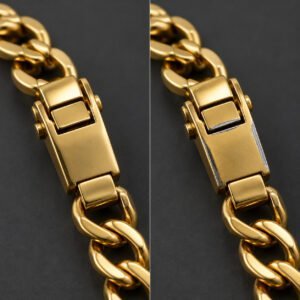
Consider two gold-colored bracelets that look almost identical when they leave the factory.
One uses a properly controlled PVD system. The other uses a typical decorative electroplating system.
Both are worn regularly and repeatedly touch a desk along the same lower edge.
On the PVD bracelet, the first sign may be fine surface scratches and a slightly polished contact area. The surface gradually becomes thinner where friction is concentrated, but the transition can remain relatively subtle for longer.
On the electroplated bracelet, the gold surface may also start with fine scratches. As the decorative layer thins, however, a different-colored underlayer may begin to appear along the contact edge.
Instead of simply seeing “a scratched gold bracelet,” the customer may now see a narrow silver, pale, or gray-colored line running through the gold finish.
Even if the exposed area is small, the contrast makes it much easier to notice.
The same thing can happen on a necklace clasp.
A PVD-coated clasp may first develop a polished friction spot where two metal parts meet. With enough repeated movement, the area can eventually wear through.
With a decorative electroplated clasp, the same contact may expose the underlayer sooner, creating an obvious change in color at the exact point the customer touches every time the necklace is opened.
That is why the visual difference after wear can matter just as much as the technical difference in coating hardness.
For many common decorative fashion-jewelry electroplating systems, repeated high-contact wear generally becomes visible earlier than it does with a well-controlled PVD system.
Why this matters more for everyday jewelry
If the brand sells the piece as a fashion item for occasional use, that difference may be acceptable.
If the product is positioned as:
- everyday jewelry;
- low-maintenance jewelry;
- waterproof or sweat-resistant jewelry;
- a long-lasting gold collection;
the customer’s expectation changes.
A small visible silver line on the bottom of a ring or beside a clasp may already feel like a product failure, even though most of the coating is still intact.
For this reason, when stainless steel jewelry is designed for regular wear and color retention is part of the selling proposition, PVD usually gives the buyer a better starting point for balancing appearance, durability, and repeat production.
From here, the practical challenge is making sure the PVD specification is actually good enough.
Consumers Judge the Finish With Their Eyes, Not a Test Report
Consumers rarely know how thick a coating is or how many cycles it survived in a laboratory.
They notice much simpler things:
Is an edge turning silver?
Does one part of the necklace look lighter than another?
Is the finish peeling?
Has a shiny gold surface become badly scratched or dull?
That means a coating can still technically exist on most of the product while the consumer already considers the jewelry “faded.”
For buyers and brands, that perception affects reviews, refunds, replacement requests, and repeat purchasing.
A useful durability requirement should therefore consider both technical coating failure and the point at which visible wear becomes unacceptable to the customer.
Product Design Changes Where the Coating Fails First
Not every jewelry category puts the same stress on its coating.A pendant may spend most of its time touching clothing or skin.The bottom of a ring can repeatedly strike desks, phones, bags, keys, and other hard surfaces.A clasp can experience metal-to-metal friction every time it opens and closes.
The result is simple:
the same PVD specification should not automatically be expected to produce the same wear life on every SKU.
Geometry can also affect coating coverage
The product shape matters before the customer even starts wearing it.
With PVD, deep recesses, narrow gaps, and hidden areas can be more difficult to coat evenly because of geometric shadowing.
Electroplating has different distribution challenges, especially around recessed areas, sharp edges, and protruding features.
This is why a thickness number without a measurement location does not tell the full story.
A more useful specification asks not only:
“What is the coating thickness?”
but also:
“What thickness do we have at the areas most likely to wear?”
Does 304 vs. 316L change the coating?
Not directly.
Using 316L does not automatically make the same PVD coating more wear-resistant than it would be on 304 stainless steel.
The substrate matters more after the coating has become scratched, thinned, or locally exposed. Because 316L generally offers stronger resistance to pitting and corrosive environments, it can help the finished product maintain a more stable appearance once the coating is locally compromised.
In practical terms:
the PVD system controls most of the surface wear; the stainless steel grade becomes more important after the surface protection is damaged.
How to Verify PVD Before Mass Production
For most projects, buyers need to prove three things:
What was actually deposited? Will it stay stable during wear? And, separately, does the product have the basic reports needed for its sales market?
The first two are the most important for this discussion.

Check 1: What is actually on the product, and how thick is it?
Terms such as “18K gold PVD” can create confusion because they may describe both a target color and part of a coating specification.
Those are not always the same thing.
Depending on the project, buyers may want third-party verification of:
- surface or coating composition;
- gold or alloy content where relevant;
- coating thickness;
- critical measurement locations.
For metallic coating thickness, ISO 3497:2000 — Metallic coatings — Measurement of coating thickness — X-ray spectrometric methods is a current international method for X-ray measurement.
ASTM B568-98(2021) — Standard Test Method for Measurement of Coating Thickness by X-Ray Spectrometry is another widely referenced method. ASTM describes the approach as suitable for determining the thickness of metallic and certain nonmetallic coatings using X-ray spectrometry.
A buyer may therefore request an XRF / Coating Thickness Test Report from a recognized laboratory such as SGS, Intertek, TÜV Rheinland, Bureau Veritas, or another accepted testing provider.
The report should identify:
- the actual sample or SKU;
- the test method;
- the measurement location;
- the measured result;
- the agreed requirement;
- the final Pass/Fail result.
One point is especially important:
ISO 3497 and ASTM B568 tell the laboratory how to measure. They do not set one universal minimum PVD thickness for all jewelry.
The required thickness should come from the approved product specification.
If the specification requires a certain minimum result at the necklace clasp or another critical location, the third-party report confirms whether that requirement has actually been met.
Check 2: Will the coating remain stable after wear?
This is the most useful part of the validation process when the brand’s real concern is fading.
Abrasion and wear testing
A controlled wear test allows buyers to compare:
- different PVD structures;
- different thickness levels;
- different suppliers;
- revised samples;
- different production batches.
One recognized laboratory method is ASTM G99-23 — Standard Test Method for Wear and Friction Testing with a Pin-on-Disk or Ball-on-Disk Apparatus.
ASTM itself makes an important point: wear depends on test conditions such as load, sliding speed, distance, materials, and environment. A laboratory result is therefore most useful as a controlled comparison; it should not automatically be converted into a claim about how many years a consumer will wear the product.
For suitable coatings and test specimens, ISO 26424 is another method used for micro-scale abrasion testing of coatings.
For a jewelry project, however, the name of the standard is only part of the specification.
A useful third-party Abrasion/Wear Test Report should clearly record:
- load;
- number of cycles;
- contact material;
- test location;
- stroke or movement;
- inspection method;
- agreed acceptance criteria.
The buyer and supplier should decide in advance what counts as failure.
For example:
- no peeling;
- no flaking;
- no visible substrate exposure on agreed primary surfaces;
- no unacceptable color change after the agreed test.
There is no honest universal rule that says:
“10,000 cycles equals two years of wear.”
The cycle requirement should match the product and the commercial expectation.
Artificial perspiration testing
Sweat is another important part of normal jewelry use.
A necklace may stay in contact with the neck for hours. Earrings contact skin. Rings and bracelets move through warm, humid, and salty conditions throughout the day.
A practical third-party reference is Intertek’s High Performance Mark — Jewelry Sweatproof program.
Intertek states that this benchmark uses the perspiration-resistance procedure in ISO 12870, Section 4.7, conditions samples in perspiration solution at 55°C for 24 hours, and requires no color change, surface degradation, corrosion, or coating separation.
That gives buyers a concrete performance benchmark rather than a supplier simply saying:
“Our jewelry is sweat resistant.”
It is still a third-party performance program, not a universal legal requirement for all jewelry.
Salt spray testing
Salt spray is useful, but it is often given more meaning than it deserves.
ISO 9227:2022 — Corrosion tests in artificial atmospheres — Salt spray tests, together with its 2024 amendment, provides a recognized method for controlled salt-spray corrosion testing.
The test can help identify corrosion weakness, pores, discontinuities, and process inconsistency.
For a concrete market benchmark, Intertek’s jewelry Tarnish-Resistant program uses a modified ISO 9227 test with 48 hours in a 5% salt-spray environment. Its published requirement includes no visible corrosion with a protection rating of at least Rp 9, together with no visible tarnishing under the defined inspection condition.
But buyers should never treat:
48 hours, 72 hours, or 96 hours of salt spray
as equivalent to:
one year, two years, or three years of consumer wear.
Salt spray is an accelerated corrosion test—not a calendar.
Check 3: Make sure the sales-market reports are covered too
This part should be handled separately from durability.
For example, EU jewelry may require nickel-release testing under REACH. EN 1811:2023 is the reference test for nickel release, while EN 12472:2020 covers accelerated wear and corrosion before nickel-release testing on coated items.
Lead, cadmium, and other restricted substances may also need to be checked depending on the market and product.
The practical rule is simple:
use reports that match the actual SKU, material, color, coating structure, and destination market.
A report for another sample should not automatically be treated as approval for an entire collection.
A Practical Example: Setting the Right PVD Standard Without Overpaying
Suppose a brand is developing an 18K gold-color stainless steel earring and necklace set.
The business goal is straightforward:
The set should look premium, hold up well in normal everyday wear, avoid unnecessary fading complaints, remain commercially priced, and still leave the brand with a healthy margin.
A practical solution would be:
Start with a proven PVD/IP specification, identify the areas that will receive the most wear, produce a sample, verify the coating and thickness, test the high-risk areas, and only increase the specification if the first version does not meet the agreed result.
That gives the buyer a clear starting point without immediately buying the most expensive coating available.
First, separate the wear risks
The earrings are relatively low-risk.
Most attention can go to:
- the visible front surface;
- closure/contact areas;
- perspiration exposure.
The necklace has more demanding mechanical points:
- chain-link contact;
- clasp;
- jump rings;
- pendant connection;
- raised edges.
So the necklace may deserve stricter wear validation than the main surface of the earrings.
Then test a reasonable first specification
The first PVD sample should be checked for:
- Actual coating and thickness Use an appropriate third-party coating/thickness report.
- Mechanical wear Focus on the necklace clasp, link-contact areas, and other high-friction locations.
- Perspiration stability Check whether the surface remains visually stable under an agreed sweat test.
- Corrosion performance, if required Use salt spray only where the product specification or buyer requires it.
If all four checks meet the agreed target, there is little reason to raise the coating cost simply to achieve a larger number on a specification sheet.
If one area fails, fix that area first
Suppose:
- the earrings pass;
- the necklace chain passes;
- the pendant passes;
- only the clasp shows early visible wear.
The wrong response would be:
“Increase the PVD specification on every component.”
A better investigation asks whether the clasp failure comes from:
- local coating thickness;
- sharp geometry;
- repeated metal-to-metal contact;
- poor coating coverage;
- pretreatment;
- the clasp design itself.
A relatively small local improvement may solve the consumer-facing problem without adding unnecessary cost to the whole set.
That is how coating decisions can support both product quality and margin.
Once the approved sample passes, freeze the important variables:
- substrate;
- surface finish;
- approved gold color;
- PVD structure;
- agreed thickness;
- critical measurement areas;
- wear-test conditions;
- perspiration requirement;
- visual Pass/Fail boundary;
- approved golden sample.
The best coating specification is not simply the highest one a factory can produce.
It is the lowest specification that consistently meets the real wear target with a reasonable safety margin.
A Simple Approval Path Before Bulk Production
Before bulk production, the goal is not to create the longest possible coating specification. It is to make sure the approved sample represents the durability level the buyer actually wants.
A practical approach is to identify the product’s highest-wear areas, choose a reasonable PVD specification, validate the sample through the agreed thickness and wear tests, correct any weak points, and then freeze the approved sample and coating requirements for production.
For a ring, that may mean paying more attention to the bottom and outer edges. For a necklace, the clasp and link-contact areas may matter more than the pendant face. The specification should follow those real wear risks rather than treating every surface the same.
Buyers do not necessarily need to work out every technical detail themselves. An experienced stainless steel jewelry manufacturer should be able to help turn a requirement such as “good for everyday wear with controlled cost” into a practical sample, coating, testing, and approval plan.
From an Approved Sample to Consistent Bulk Production
Passing a wear test is only useful if the same coating quality can be repeated in bulk production. Once the approved color, coating structure, thickness, critical wear areas, and test conditions are confirmed, the next challenge is keeping those requirements consistent from sample approval through repeat orders.
Chicolink Jewelry is a stainless steel jewelry manufacturer in Dongguan, China, serving B2B buyers through wholesale, OEM, ODM, private-label, quality-control, and bulk-production services. The company was established in 2012 and operates its own in-house plating workshop.
For PVD/IP projects, Chicolink can manage the coating process together with the rest of the production workflow rather than treating plating as a separate, undefined finishing step. Its in-house plating operation includes six PVD vacuum coating systems and covers process setup, pretreatment coordination, color and sample approval, production monitoring, quality inspection, exception handling, and batch traceability.
Coating specifications can be defined around the actual product, including the substrate, product structure, polishing level, approved color sample, PVD/IP or electroplating route, layer materials, target thickness, color tolerance, wear, perspiration and salt-spray requirements, and destination market. Final coating checks can include thickness, color comparison, color difference, missed coating, pinholes, scratches, and peeling.
Chicolink also uses coating-color samples, pre-production samples, golden samples, and retained samples to help keep the approved version connected to later production. Sample records can be linked to the relevant SKU, drawing, BOM, process version, approval status, and reference photos.
For buyers who already have a detailed coating specification, this provides a clear production reference. For brands that only know the commercial goal—such as better color retention for everyday wear without pushing the product beyond its target cost—Chicolink can also help turn that requirement into a practical coating, sample, testing, and approval plan before bulk production.
The objective is simple: make the durability approved in the sample something that can be reproduced in the actual order.