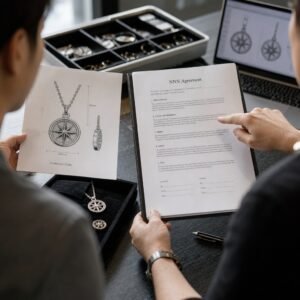
When you work with a jewelry manufacturer, sharing your designs is part of the process. Whether you’re launching your first private-label collection or developing new products for an established brand, your supplier needs enough information to turn your ideas into finished jewelry. That often means providing sketches, CAD files, technical drawings, and product specifications—materials that may have taken months to develop.
But once those files leave your hands, an important question comes up: How do you make sure your designs are used only for your orders? You may also wonder whether the factory can show your products to other buyers, reuse custom molds, or share information about your customers. These aren’t necessarily signs that a manufacturer is untrustworthy. They’re practical questions that deserve clear answers before production begins.
An NNN agreement (Non-Disclosure, Non-Use, and Non-Circumvention) is one way to address these concerns. It’s a contract that sets rules for how a manufacturer can handle your confidential information, use your designs, and deal with certain business relationships. While you may already be familiar with a standard NDA, an NNN agreement goes further by explicitly addressing unauthorized use and attempts to bypass your business.
NNN agreements are especially useful when working with overseas manufacturers, where differences in business practices, legal systems, and production arrangements can make design protection more challenging. However, an NNN agreement isn’t a guarantee against copying, nor does it replace intellectual property protection or proper production management. In this guide, we’ll explain how NNN agreements work, what they can protect, and what jewelry brands should consider to protect their designs and business interests throughout the manufacturing process.
What Is an NNN Agreement?
An NNN agreement is a legal contract designed to prevent unauthorized disclosure and use of protected information, as well as certain attempts to bypass business relationships. It’s commonly used in international manufacturing, particularly when brands need to share original designs or commercially sensitive information with overseas suppliers.
NNN stands for three types of contractual protection:
- Non-Disclosure: Restricts the manufacturer from sharing protected designs, technical files, or confidential business information with unauthorized third parties.
- Non-Use: Prevents the manufacturer from using protected information outside the agreed project, such as producing a customer’s original design for another buyer without permission.
- Non-Circumvention: Restricts the manufacturer from using protected business contacts or opportunities to bypass the brand in ways prohibited by the agreement.
The purpose is straightforward: to define what the manufacturer is allowed to do with your information before you share it.
For example, suppose your brand provides a custom stainless steel bracelet design to a manufacturer. The factory is authorized to use your drawings to develop samples and fulfill your production orders. However, that permission doesn’t automatically allow it to sell your design to another customer, display it in its catalog, or use your distributor information to pursue independent business.
An NNN agreement can make these boundaries clear for both parties. However, NNN is not a separate form of intellectual property registration or a universal legal document with identical rules in every country. Its effectiveness depends on the actual contract terms and applicable law.
Why Do Jewelry Brands Consider NNN Agreements When Working With Manufacturers?
The main reason is simple: your manufacturer needs access to your designs to produce your jewelry, but that access shouldn’t give it unrestricted rights to use them.
Manufacturers Need Detailed Design Information
Custom jewelry production requires more than a reference photo. A factory may need CAD models, technical drawings, dimensions, material specifications, and physical samples to understand how a product should be made.
For example, when developing a custom 316L stainless steel pendant, the manufacturer may need a 3D model showing its exact shape, dimensions, and engraving details. The engineering team may also review its thickness, chain connection, and surface finish to determine how the design can be manufactured consistently.
These details are necessary for accurate sampling and production, but they may also contain enough information to reproduce the design without further input from the brand.
That’s why it’s worth establishing clear usage restrictions before sharing complete design files, especially for exclusive or unreleased collections.
Manufacturers May Also Receive Sensitive Business Information
Design files aren’t the only valuable information exchanged during production. Depending on the project, a supplier may learn about:
- Product costs, target prices, and order quantities
- Upcoming collections and launch schedules
- Customer names and distributor information
- Private-label packaging and shipping requirements
For wholesale jewelry brands, some of these details can reveal important information about pricing strategies, sales channels, and customer relationships.
A manufacturer may need certain information to complete an order, but it doesn’t necessarily need unrestricted access to everything about your business.
Why Isn’t a Standard NDA Always Enough?
A traditional non-disclosure agreement (NDA) focuses primarily on keeping confidential information private. But preventing disclosure isn’t always the same as preventing unauthorized use.
Imagine sending an original necklace design to a manufacturer. The factory keeps your CAD file confidential but uses it to produce similar necklaces for another wholesale buyer. The issue isn’t necessarily that the file was disclosed—it’s that the design was used without authorization.
An NNN agreement addresses this distinction through explicit non-use and non-circumvention provisions.
That doesn’t mean every NDA is insufficient. A properly drafted NDA can include similar restrictions. The important question is what the contract actually prohibits, not what it’s called.
Non-Disclosure: How Does It Protect Jewelry Designs and Confidential Information?
Non-disclosure provisions protect sensitive information by restricting who can receive it and how it may be shared.
For jewelry brands, this can include original sketches, CAD files, prototypes, technical drawings, unreleased product images, and confidential business documents. The agreement should identify protected information clearly enough that both parties understand their responsibilities.
Protecting CAD Files, Designs, and Product Information
In custom jewelry manufacturing, CAD files and technical drawings deserve particular attention because they often contain the details needed to reproduce a product.
For example, a brand developing an exclusive stainless steel pendant may provide a complete 3D model showing its shape, dimensions, and decorative details. The factory needs this information for sampling and production, but it shouldn’t be free to forward the files to unrelated buyers or suppliers.
An NNN agreement can establish restrictions on storing, copying, sharing, and accessing these materials. It may also prevent the manufacturer from displaying confidential designs in its wholesale catalog, at trade shows, or on social media without approval.
The same protection can apply to commercial information. If your manufacturer knows about an upcoming collection, target pricing, or an exclusive retail launch, the agreement can require it to keep those details confidential.
What About Subcontractors?
This is an important detail that jewelry brands sometimes overlook.
Not every manufacturer handles every production step in-house. Specialized processes such as PVD coating, polishing, engraving, or packaging may involve outside partners. Depending on the project, those subcontractors may need access to product drawings or samples.
A practical NNN agreement should clarify four things:
- Whether subcontracting requires the brand’s approval
- What information approved subcontractors may receive
- What confidentiality obligations those subcontractors must follow
- Who is responsible if protected information is mishandled
For particularly sensitive projects, direct confidentiality commitments from key subcontractors may also be appropriate.
The goal isn’t to make manufacturing more complicated. It’s to make sure confidential information stays protected throughout the production process, even when more than one company is involved.
Non-Use: How Can It Prevent Unauthorized Use of Original Jewelry Designs?
Non-use provisions restrict what a manufacturer can do with your protected designs and information, even if those materials are never shared with anyone else.
For custom jewelry brands, this is one of the most important parts of an NNN agreement.
Preventing Designs From Being Used for Other Orders
When you share an original design with a factory, you’re generally authorizing its use for a particular purpose, such as quotation, sampling, or production under your purchase orders.
A non-use provision can prevent the manufacturer from using that protected design to produce jewelry for another customer without permission.
For example, suppose your brand develops a distinctive stainless steel necklace and pays for sample development. The manufacturer may be authorized to produce your orders, but that doesn’t automatically allow it to make additional necklaces for other buyers or include the design in its own wholesale collection.
Non-use restrictions can also address modifications based on protected information. Changing a pendant’s dimensions, replacing a decorative detail, or switching from polished stainless steel to a gold-colored PVD finish doesn’t necessarily make unauthorized use of the original design acceptable.
However, the restrictions should have clear boundaries. They shouldn’t automatically prevent a manufacturer from using its own existing designs, producing common jewelry styles, or independently developing products without relying on your protected information.
Protecting Custom Molds and Tooling
Custom molds and tooling are another area where clear usage rights matter.
Depending on the manufacturing method, a custom jewelry project may require dedicated molds, dies, fixtures, or other production tools. If your brand pays to develop tooling for a signature pendant, you’ll want to know whether that tooling can be reused for another customer’s order.
An NNN agreement can restrict unauthorized use, but tooling ownership should also be addressed in a separate manufacturing or tooling agreement.
Make sure the following points are clearly documented:
- Ownership: Who legally owns the mold or tooling?
- Usage rights: Can it be used exclusively for your orders?
- Storage and access: Where will it be kept, and who can use it?
- Transfer rights: Can you retrieve or transfer it if you change manufacturers?
These details should be agreed upon before tooling development begins. Paying for custom tooling doesn’t automatically settle every ownership or usage question.
Defining Authorized and Unauthorized Production
A useful non-use clause should distinguish normal manufacturing activities from unauthorized commercial use.
For example, a factory may need to copy CAD files internally, produce engineering samples, or adjust production settings to complete an approved order. These activities can be permitted when they fall within the agreed project.
However, producing extra units for independent sale, using customer-specific tooling on unrelated orders, or selling products made from a protected design may fall outside that authorization.
Brands should also address production overruns, rejected products, and surplus inventory. The agreement should explain whether these items may be retained, reused, sold, or must be handled according to the brand’s instructions.
This is particularly relevant for larger wholesale orders, where even a small percentage of additional production can represent a significant number of products.
Non-Circumvention: How Does It Protect a Jewelry Brand’s Business Relationships?
Non-circumvention provisions address a different concern: protecting certain business relationships and opportunities that a manufacturer learns about through your partnership.
For B2B jewelry brands, customer relationships can be just as valuable as original product designs.
What Does Circumvention Look Like?
Imagine your brand supplies jewelry to several retail chains. During production, your manufacturer receives shipping documents, packaging instructions, or other information that identifies some of your customers.
If the manufacturer uses those contacts to approach your customers directly and offer competing products while bypassing your brand, that may be the type of conduct a non-circumvention clause is intended to restrict.
The key issue is whether the manufacturer is using protected contacts or business opportunities obtained through your relationship in a way the contract prohibits.
This matters because wholesale jewelry brands invest considerable resources in building distribution networks, developing retail accounts, and maintaining customer relationships. Those investments deserve appropriate protection.
How Can Brands Reduce This Risk?
The most practical approach is to control how business information is shared and clearly define what the manufacturer is allowed to do with it.
For example, you might manage distributor negotiations directly while allowing the factory to communicate with a logistics contact about deliveries. If direct customer communication is necessary, the agreement can specify its permitted purpose.
A non-circumvention clause should also identify the relationships it protects, such as specified customers, distributors introduced by the brand, or particular commercial opportunities disclosed during the project.
The restrictions should be reasonable and clearly defined. They shouldn’t automatically prevent a manufacturer from serving existing customers or pursuing unrelated business.
The goal is to protect the relationships your brand has built, not to restrict legitimate manufacturing business.
What Should an NNN Agreement for Jewelry Manufacturing Include?
An effective NNN agreement should reflect how your manufacturing project actually works.
A generic template may cover basic confidentiality but overlook practical issues such as CAD file access, custom tooling, subcontractors, and production overruns.
For jewelry manufacturing, the following six areas deserve particular attention.
6.1 Definition of Protected Information
The agreement should clearly identify what information is protected, including original sketches, CAD files, technical drawings, prototypes, product specifications, tooling information, packaging designs, pricing, and confidential customer records.
It should also explain how protected information is identified and what exceptions apply. Information already publicly available or independently developed without using the brand’s protected materials, for example, may fall outside the restrictions.
6.2 Non-Disclosure Obligations
The contract should define who may access confidential materials and when information can be shared.
For jewelry projects, this should cover technical documents, physical samples, unreleased products, and confidential project photographs. It should also clarify whether customer-specific designs can appear in catalogs, trade shows, or online marketing.
6.3 Non-Use Restrictions
The agreement should limit protected information to authorized purposes, such as quotation, sampling, tooling development, and production under approved orders.
It should also address unauthorized reproduction, modifications based on protected designs, additional production, and the use of customer-specific tooling.
Where the factory contributes its own pre-existing designs or manufacturing knowledge, those assets should be clearly distinguished from the brand’s proprietary information.
6.4 Non-Circumvention Restrictions
This section should identify the customers, distributors, or commercial opportunities being protected and explain what conduct is restricted.
It should also establish the duration and reasonable exceptions. A clearly defined clause is generally more practical than a broad restriction covering every possible future business relationship.
6.5 Subcontractor and Affiliate Responsibilities
If production involves subcontractors, affiliated factories, or trading companies, the agreement should explain how those parties are handled.
It should specify whether approval is required before protected information is shared and who is responsible if an approved subcontractor breaches its obligations.
Remember that an agreement signed by one company doesn’t automatically bind every related business. Separate contractual commitments may sometimes be necessary.
6.6 Agreement Duration and Remedies
The contract should state when its obligations begin, how long they last, and which restrictions continue after the manufacturing relationship ends.
It should also address the return or deletion of confidential materials, subject to any agreed retention requirements.
Finally, the agreement should explain how disputes will be resolved and what remedies may be available for a breach. Depending on the applicable law, these may include damages or other legal remedies. However, agreed damages amounts aren’t automatically enforceable in every jurisdiction.
Because these provisions directly affect enforceability, professional legal review is important.
What Are the Limitations of an NNN Agreement?
An NNN agreement can help reduce manufacturing risks, but it isn’t a guarantee that your designs will never be copied or misused.
Understanding its limitations will help you decide what additional protections your brand needs.
A Signed Agreement Doesn’t Eliminate Every Risk
An NNN agreement creates contractual obligations. It cannot physically prevent someone from copying a file, reproducing a product, or improperly sharing information.
If a dispute occurs, you may still need evidence showing what information was provided, what restrictions applied, and how those restrictions were breached.
This is why it’s useful to keep organized records of CAD files, design revisions, sample approvals, and important project communications.
It’s equally important to evaluate a manufacturer’s reputation, transparency, and willingness to follow agreed confidentiality procedures before sharing sensitive materials.
Enforcement Depends on Applicable Law
Cross-border contracts can be more complicated to enforce than domestic agreements.
A jewelry brand based in the United States or Europe may work with a manufacturer in China, Vietnam, Thailand, or another production market. Each jurisdiction has its own contract rules, dispute-resolution procedures, and available remedies.
For example, a contract governed by U.S. law and subject to U.S. courts isn’t necessarily the most practical option for enforcing obligations against a manufacturer in mainland China.
The appropriate governing law, contract language, dispute-resolution method, and enforcement arrangements should be considered before signing.
NNN Agreements Don’t Replace Intellectual Property Rights
An NNN agreement creates contractual obligations between the parties bound by it. It doesn’t automatically give your brand exclusive intellectual property rights against everyone else in the market.
Depending on the design and jurisdiction, other forms of protection may be relevant:
- Design patents or registered design rights: May protect qualifying ornamental jewelry designs or product appearances.
- Trademarks: May protect brand names, logos, and other qualifying brand identifiers.
- Copyright: May protect certain original creative elements where legal requirements are met.
- Trade secrets: May protect qualifying confidential technical or business information.
For example, an original pendant design may qualify for design protection, while confidential development files and production details may be protected through contractual restrictions.
According to the World Intellectual Property Organization (WIPO), trade secret protection generally requires information to be commercially valuable because it is secret, known only to a limited group, and subject to reasonable measures to maintain its secrecy.
Information that becomes publicly available or is independently developed by another party may not receive the same protection.
NNN agreements and intellectual property rights serve different purposes. For many jewelry brands, using them together provides more complete protection.
Good Production Management Still Matters
Even a carefully written agreement may offer limited practical protection if confidential files are shared without control, custom molds aren’t properly tracked, or subcontractors receive sensitive information without appropriate safeguards.
In custom jewelry manufacturing, reliable production also depends on keeping the approved sample, technical specifications, finish references, and quality requirements consistent.
For example, a brand ordering the same necklace in several PVD colors needs the manufacturer to distinguish each approved finish and apply the correct specifications to future production batches. The same applies to logo placement, engraving details, dimensions, and packaging requirements.
Clear design records, sample approvals, tooling arrangements, and production controls help protect the integrity of the original product while reducing avoidable mistakes.
These measures don’t replace contractual protection, but they make the entire manufacturing process more reliable.
How Can Jewelry Brands Include NNN Agreements in Their Sourcing Process?
The best time to establish design protection is before sensitive information is shared.
You don’t need to turn every sourcing conversation into a complicated legal process. A few practical steps at the right stages can make a meaningful difference.
Step 1: Initial Supplier Contact
Start by discussing general product requirements, such as materials, manufacturing capabilities, order quantities, and finishing options.
For example, you can ask whether a supplier produces custom 316L stainless steel jewelry, supports PVD coating, or offers private-label packaging without immediately sending your complete CAD files.
Share enough information to evaluate the supplier, but keep your most sensitive design details for later.
Step 2: Before Sharing Complete Design Files
Once you’ve identified a suitable manufacturer, confirm which legal company will receive the files and perform the project.
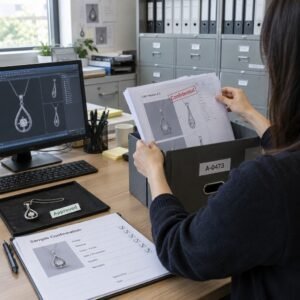
Have the appropriate NNN agreement signed before providing confidential CAD models, technical drawings, or unreleased designs. Keep a record of what you share, including file versions, dates, and recipients.
Step 3: During Sampling and Tooling Development
Clarify ownership and usage rights for original designs, newly developed CAD files, and custom tooling.
Document sample approvals, including important dimensions, surface finishes, and branding details. Require authorization for significant design changes and follow the agreed confidentiality procedures if subcontractors are involved.
Step 4: During Mass Production and Long-Term Cooperation
Continue applying design protection procedures after the first order.
Make sure your manufacturing agreement addresses approved quantities, surplus products, unauthorized resale, and tooling management. For repeat orders, keep approved samples, specifications, and relevant quality records connected to each product or SKU.
These steps help turn contractual requirements into normal parts of the sourcing process, making the manufacturing relationship easier to manage for both sides.
How Can Jewelry Brands Make NNN Agreements More Practical for Cross-Border Manufacturing?
An NNN agreement should do more than look complete on paper. When working with an overseas jewelry manufacturer, the agreement needs to fit the supplier’s legal environment and the way production actually works.
You don’t need to understand every detail of international contract law. However, there are a few important things worth checking before sharing your designs or placing an order.
9.1 Make Sure the Agreement Works Across Borders
Contract laws and enforcement procedures vary between countries. An agreement written for a U.S. supplier may not be appropriate for a manufacturer operating elsewhere.
Before signing, focus on three essentials:
- Governing law: Which country’s laws will apply to the agreement?
- Dispute resolution: Where and how will contractual disputes be handled?
- Enforceability: Are the restrictions and remedies appropriate under the relevant legal system?
You should also confirm that the agreement identifies the correct legal company and is properly executed by an authorized party.
This is especially important when a sourcing agent, trading company, or separate production facility is involved. The business communicating with you may not be the same legal entity that will receive your design files or manufacture your jewelry.
For valuable original designs or larger manufacturing projects, a lawyer familiar with the supplier’s jurisdiction can help determine whether the agreement is suitable.
9.2 Make Sure the Contract Matches the Production Process
An agreement is most useful when its requirements can be followed during everyday production.
For custom jewelry, this means connecting contractual restrictions with practical decisions about CAD files, samples, tooling, and subcontractors.
For example, suppose your project involves a custom stainless steel pendant with a particular shape, laser-engraved logo, and PVD finish. The manufacturer may need several technical and production teams to review different parts of the design.
The agreement should make clear which information can be shared for those authorized activities and whether outside suppliers need approval before receiving protected materials.
Your manufacturing contract should also address issues that an NNN agreement may not fully cover, such as tooling ownership, approved product specifications, quality requirements, and delivery terms.
The goal is to make design protection part of the manufacturing workflow, rather than relying on a signed document alone.
9.3 A Practical Example: Working With a Jewelry Manufacturer in China
China is a useful example of why local legal requirements and practical production arrangements both matter.
Many international jewelry brands source from Chinese manufacturers because of their experience with custom product development, specialized finishing processes, and large-scale production. But a brand based in the United States or Europe still needs to make sure its agreements are appropriate for the Chinese company it works with.
China’s legal system recognizes obligations concerning confidential information. For example, Article 501 of the Chinese Civil Code prohibits the improper disclosure or use of trade secrets and other information that should be kept confidential when learned during contract negotiations, even if no final contract is formed.
However, this doesn’t mean every misuse of a jewelry design is automatically covered, or that a standard foreign contract will be straightforward to enforce in China.
When working with a mainland Chinese manufacturer, buyers should pay particular attention to the company’s registered Chinese legal name, proper contract execution, and any applicable company seal requirements. They should also consider whether a Chinese or bilingual agreement is appropriate and which language version will control if differences arise.
These details help establish a clearer legal foundation for the partnership.
Equally important is understanding how the manufacturer will handle your project after the agreement is signed. A factory that can explain its design review, sampling, tooling arrangements, production processes, and quality checks gives you a better basis for evaluating how your requirements will be managed.
This is particularly relevant for custom stainless steel jewelry, where a product may move through several manufacturing stages before it is ready for sale.
9.4 Choose a Jewelry Manufacturer That Takes Design Protection Seriously
An NNN agreement sets important legal boundaries, but a reliable manufacturing partner is what helps turn those expectations into everyday practice. Beyond production capabilities and pricing, look for a supplier who understands the value of your original designs, communicates clearly, and is willing to discuss confidentiality, tooling rights, and authorized production before your project begins.
At Chicolink Jewelry, we understand these priorities. As an experienced stainless steel jewelry manufacturer in China, we support jewelry brands and wholesale buyers with comprehensive OEM/ODM services, including design development, sampling, custom manufacturing, PVD finishing, laser engraving, quality control, and private-label packaging. Our goal is to help brands bring their designs to market while maintaining clear product requirements and consistent manufacturing standards.
We know that every original collection represents an investment in your brand. That’s why we believe design ownership, confidential information, custom tooling, and production permissions deserve clear discussion from the start. If you have an NNN agreement or specific design protection requirements, our team welcomes the opportunity to review and discuss them with you before production moves forward.
Ready to Develop Your Custom Stainless Steel Jewelry Collection?
Whether you’re launching a new private-label collection or expanding an established jewelry line, we’re here to support your manufacturing needs.
Contact Chicolink Jewelry to discuss your designs, confidentiality concerns, customization requirements, and production plans. Let’s build a manufacturing partnership that respects your original work and supports your brand’s long-term growth.